CE Approved Compact Excavators: The Overview to Compliance
CE Approved Compact Excavators: The Overview to Compliance
Blog Article
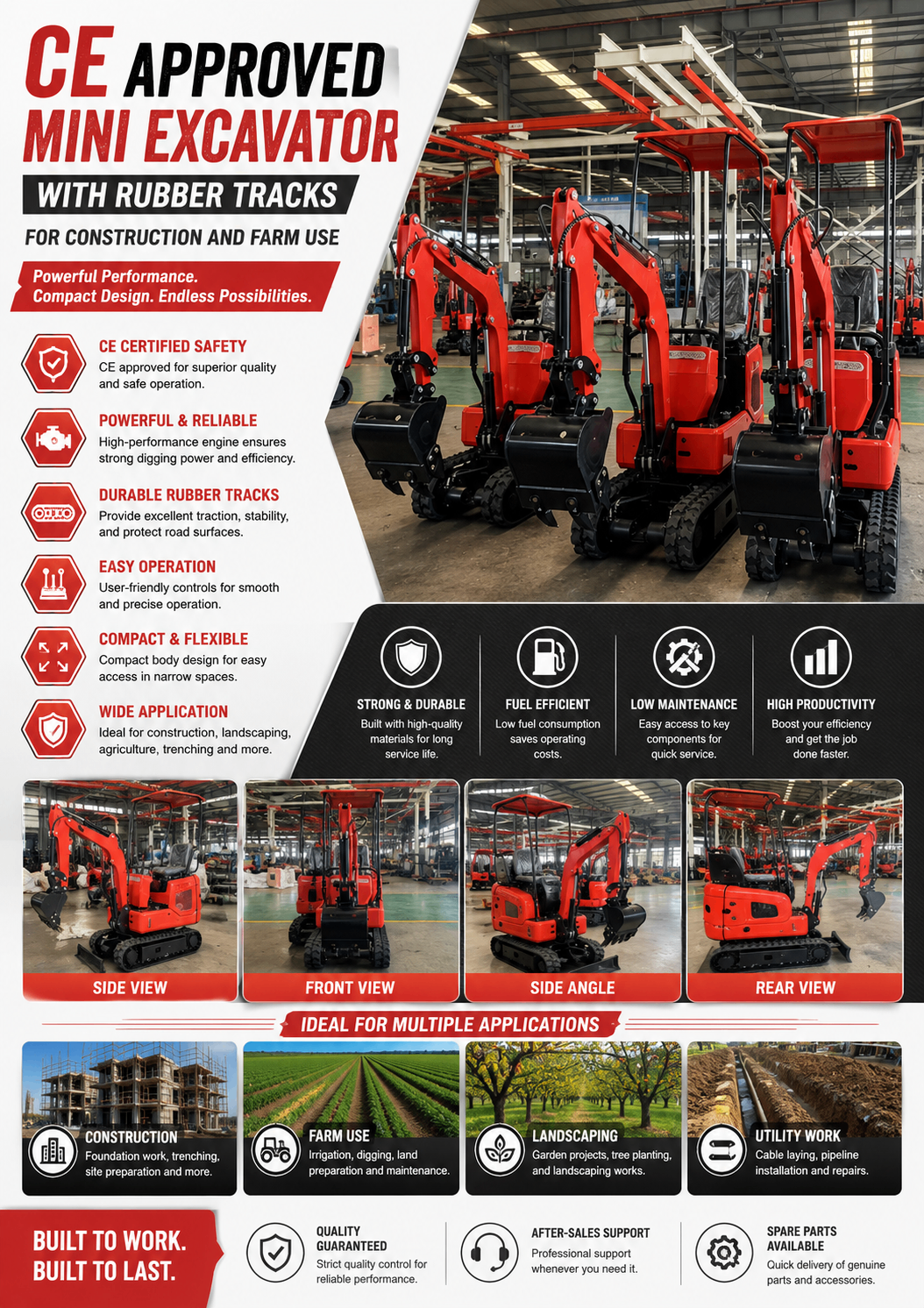
Ensuring your mini machine meets EU accreditation requirements is vital for sales within the EU. get more info These guide details the necessary aspects of CE approval for mini diggers, such as regulations related to operator protection, equipment assessment, and paperwork. Understanding the specifications permits businesses to correctly use their equipment and circumvent serious fines.
Steel Track Mini Excavators: Excellent Grip for Challenging Terrain
Mini diggers equipped with composite tracks are revolutionizing how contractors handle projects in uneven conditions. Unlike traditional tire-equipped models, these versatile machines deliver superior grip on unstable surfaces like gravel, snow, and steep grades. This greater control allows operators to complete tasks securely and productively, minimizing downtime and maximizing productivity. The compliant nature of composite tracks also reduces ground pressure, preserving delicate surfaces and lessening environmental disturbance.
Small Machines: Significant Output in Limited Construction Locations
These robust reduced-size excavators provide a considerable solution for jobs where traditional equipment simply maneuver. Their reduced footprint allows access to challenging areas, such basement systems or within existing buildings. Despite their scale, they feature substantial digging power and precision, allowing them ideal for a broad spectrum of demolition uses. Ultimately, small excavators represent a efficient tool for contractors facing the problems of confined areas.
Compact Machines for Agricultural Land : Versatility and Productivity in Agricultural Operations
Modern farming operations often require equipment that can handle a scope of challenging jobs. Mini excavators are quickly becoming invaluable assets for farmers , offering exceptional adaptability and efficiency across a diverse array of farming operations . From digging for irrigation networks and runoff to relocating earth for constructing barriers or platforms, these devices provide a capable solution. They even excel at clearing land for cultivation, grading fields , and handling substances with simplicity . Their reduced size allows them to work in limited locations that larger vehicles simply cannot reach .
- Trenching for Irrigation
- Relocating Soil
- Removing Land for Planting
Determining the Appropriate Mini Digger regarding Building vs. Rural Tasks
When choosing a mini excavator , it's vital to understand the crucial variations between construction projects and farm operations . Construction sites often demand greater power , accuracy , and the capacity to work in small areas . Consequently , a robust model with a broad range of attachments might be preferable. Conversely , rural properties frequently involve less digging amounts, routine terrain leveling , and the necessity for compact equipment to traverse open areas. In conclusion, careful assessment of the planned workload is essential for securing the optimal selection .
- Consider digging requirements.
- Determine the location constraints .
- Review the necessary tools .
- Consider moving difficulties .
{CE Marking & Mini Compact Equipment: What Operators Need to Know
Ensuring your {mini digger is adheres to relevant European regulations is crucial, and that's where {CE certification comes into play . This identification demonstrates that the device has been assessed and meets performance requirements, allowing unrestricted sale within the EEA . {For owners of these machines, understanding CE labeling is vital . It isn't simply about having a mark on the digger; it represents a assessment of manufacturing and functionality.
- Check the existence of the CE mark .
- Consult the conformity document – this details the standards the digger meets.
- Think about that CE labeling is the supplier's responsibility – even operators must be cognizant of its significance.